Introduction
Building a reliable UAV platform requires much more than selecting a motor with high power output.
Many drone manufacturers experience performance problems after integration, including insufficient thrust, short flight time, excessive vibration, overheating, and unstable flight control.
A motor that performs well on a test bench may not deliver the expected results when combined with a specific propeller, battery system, payload, and flight mission.
At Smart Drive, we help OEM teams create dependable custom UAV motor solutions for a wide range of UAV applications. Covering motor evaluation, electromagnetic design, prototype development, testing and low-volume manufacturing, we deliver full-cycle development support.
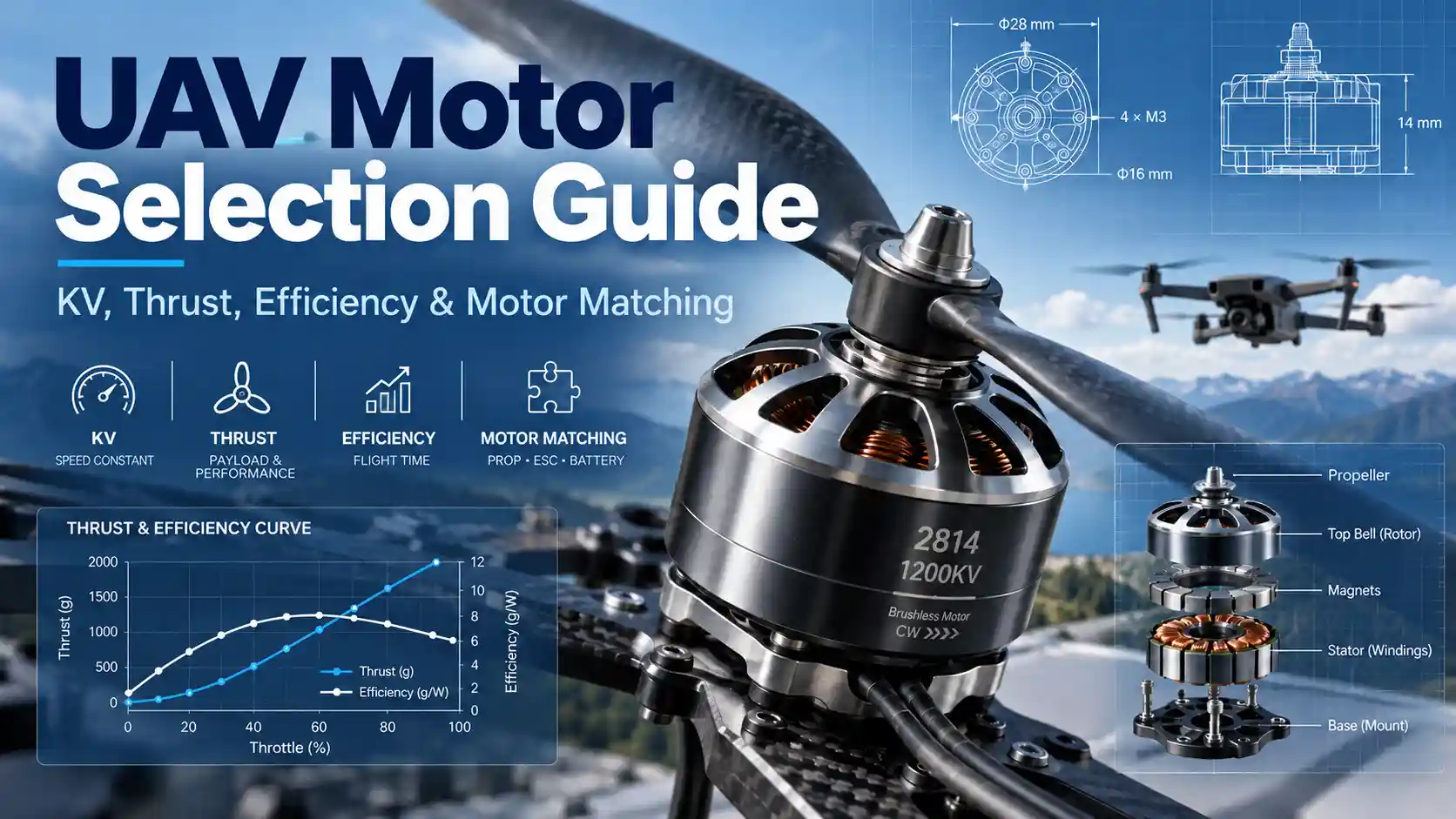
This UAV Motor Selection Guide explains how engineers can select the right BLDC motor for different drone platforms by evaluating thrust requirements, motor-propeller matching, efficiency, thermal performance, control strategy, and mechanical integration.
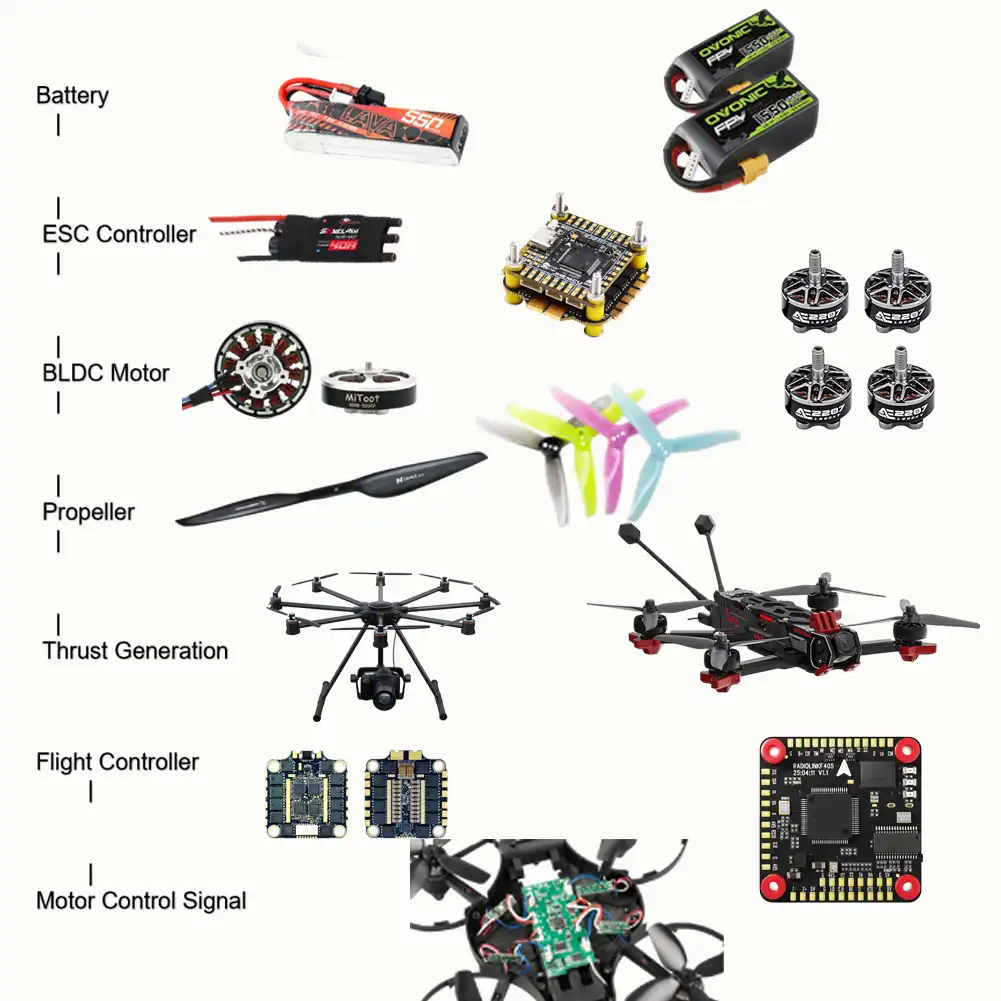
Selecting the correct UAV motor requires understanding the complete propulsion system. The motor, propeller, ESC, battery, and flight controller must work together to achieve efficient and stable flight performance.
Why Is UAV Motor Selection Important for Drone Performance?
A UAV motor is the core component of the aircraft propulsion system.
It converts electrical energy from the battery into mechanical power that drives the propeller and generates thrust.
Unlike many industrial motor applications, UAV motors operate under strict weight and efficiency limitations.
Every additional gram affects:
- Flight endurance
- Payload capability
- Energy consumption
- Overall system efficiency
For example:
A consumer photography drone typically prioritizes quiet operation, stable flight, and long flight time.
A racing drone requires rapid acceleration and high dynamic response.
An agricultural spraying UAV requires continuous torque output and thermal stability.
A heavy-lift drone requires high power density and structural reliability.
Therefore, there is no universal motor solution for every UAV platform.
A successful selection process starts with understanding the aircraft mission, not simply comparing motor specifications.
UAV Motor Selection Guide: Key Parameters for Professional Drone Development
When selecting a motor for a UAV platform, I recommend evaluating the complete operating environment.
The most important factors include:
- Required thrust
- Motor weight
- KV rating
- Propeller compatibility
- Battery voltage
- Efficiency
- Thermal capability
- Control system compatibility
- Reliability requirements
A correct selection process helps reduce redesign costs and improves the probability of successful prototype validation.
1. Match Motor Thrust With UAV Weight and Payload
Thrust is the first parameter engineers should define.
The motor must provide enough thrust to support:
- Aircraft structure
- Battery weight
- Payload
- Additional safety margin
A common mistake is selecting motors only based on rated power.
However, power alone does not determine flight performance.
The actual thrust depends on the interaction between:
- Motor
- Propeller
- Battery voltage
- ESC
- Operating condition
For example, a larger propeller usually requires:
- Higher torque
- Lower motor speed
- Stronger mechanical structure
A smaller propeller usually requires:
- Higher RPM
- Faster response
- Higher KV motor characteristics
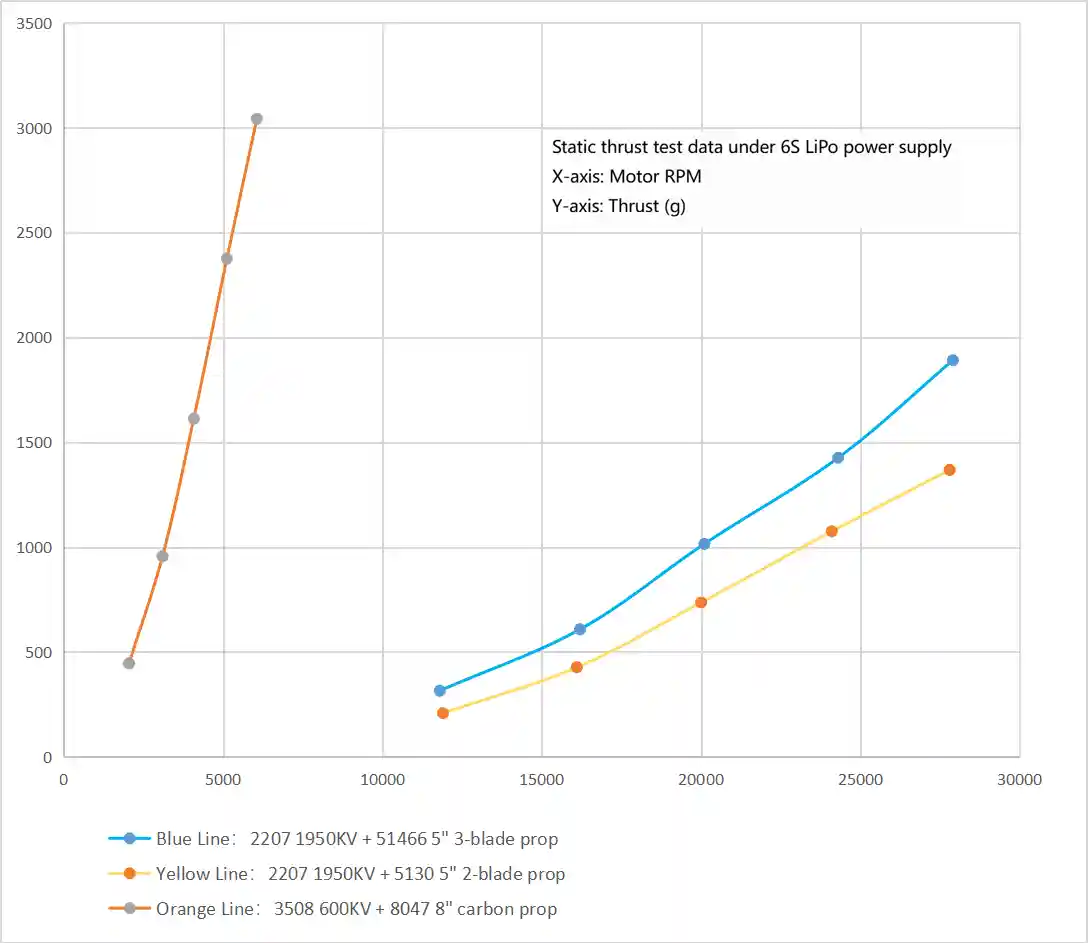
During UAV motor development, I evaluate the motor and propeller combination together instead of selecting the motor independently.
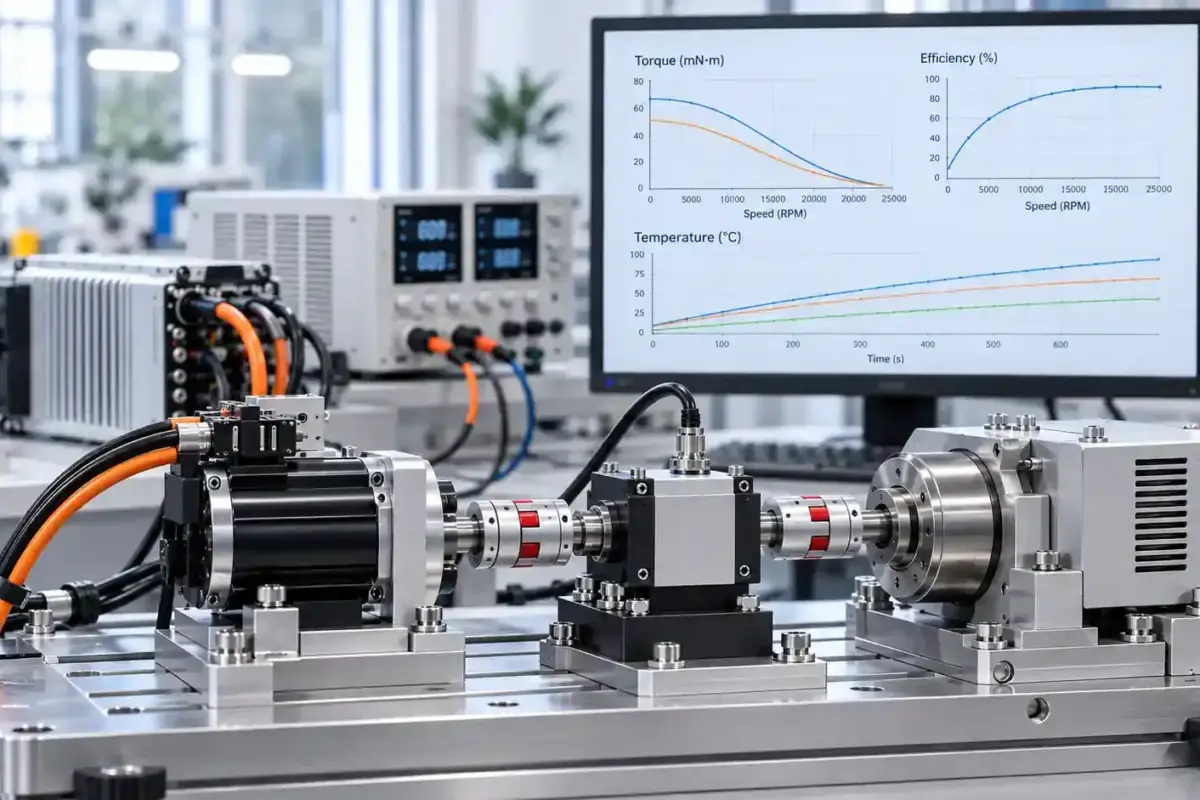
For professional UAV platforms, thrust testing and efficiency measurement are essential before moving into production.
Typical Thrust-to-Weight Design References:
These ratios are preliminary design references rather than mandatory limits. Final thrust margin should be verified through propeller, motor, battery, and ESC testing.
Aerial Photography Drones:
Total Aircraft Weight ÷ Number of Motors × 1.8~2.2 (Safety Margin)
FPV Racing Drones:
Total Aircraft Weight ÷ Number of Motors × 2.5~3 (Maneuver & Flip Margin)
Heavy-Lift Industrial Drones:
Total Aircraft Weight ÷ Number of Motors × 2.0~2.5
2. Understand KV Rating and Propeller Matching
KV rating is one of the most important specifications in UAV motor selection.
KV = No-load motor speed per volt of applied voltage (rpm/V)Unit: RPM/V
Formula core definition:
KV=N0/U
N0: No-load speed (rpm, no propeller installed)
U: DC input voltage of motor (V)
For example:
A 1000KV motor theoretically rotates faster than a 500KV motor under the same voltage condition.
However, higher KV does not always mean better performance.
High KV motors usually provide:
Higher no-load speed per volt
Better compatibility with smaller, high-speed propellers
Faster dynamic response in suitable propulsion systems
Low KV motors usually provide:
Higher torque constant (more torque per amp for a comparable motor)
Better compatibility with larger propellers
Lower operating speed for a given voltage
The correct KV selection depends on:
- Propeller diameter
- Blade pitch
- Battery voltage
- Aircraft weight
- Flight objective
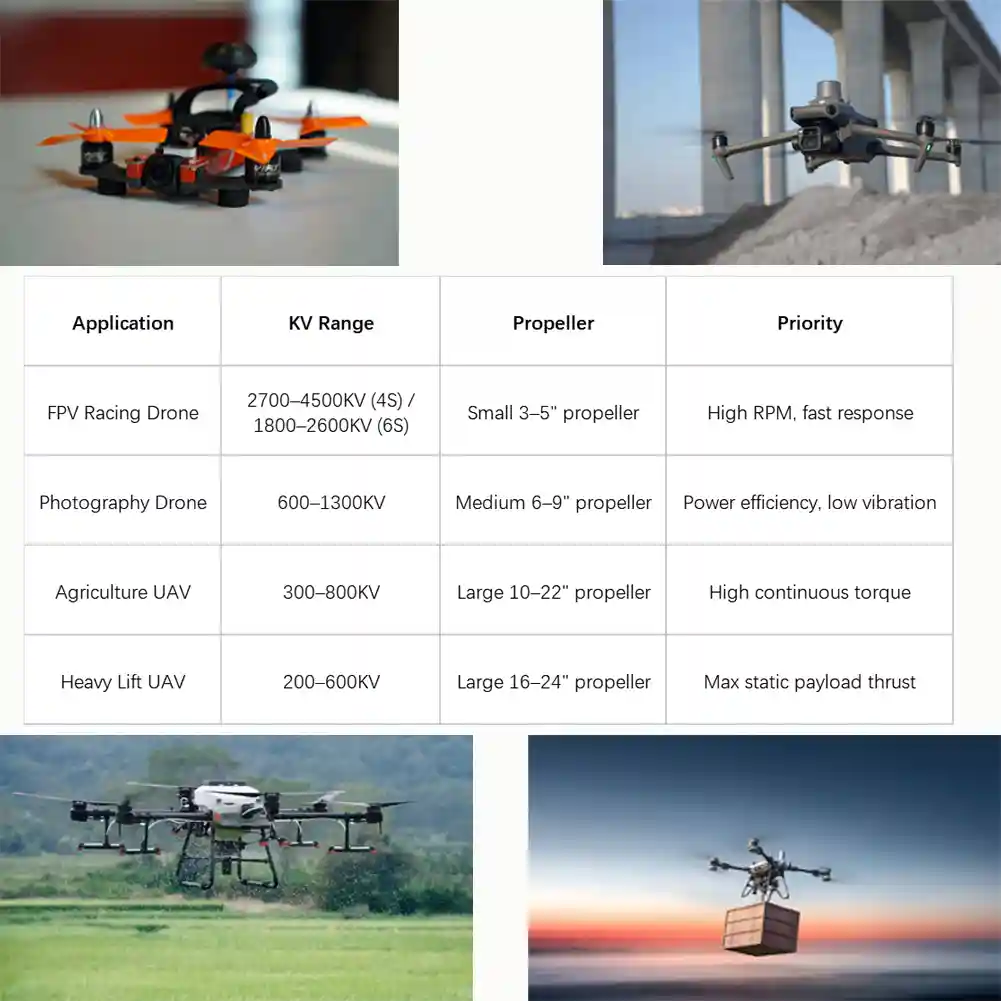
A professional UAV Motor Selection Guide should always evaluate KV together with the complete propulsion system.
3. Select Battery Voltage and Electrical Parameters
Voltage selection directly affects motor efficiency and thermal performance.
Common UAV battery systems include:
1S/2S: Mini and indoor drones
3S/4S: Small FPV and lightweight multirotor platforms
6S: High-performance FPV, long-range, and medium-size multirotor systems
8S/12S: Larger industrial, heavy-lift, and VTOL platforms
Higher voltage systems can reduce current demand for the same power output.
Lower current helps:
- Reduce copper losses
- Improve efficiency
- Reduce heat generation
However, voltage must match:
- ESC rating
- Motor winding design
- Battery configuration
- Flight controller requirements
A motor designed for a 4S system may not achieve the expected performance when used with a 2S battery because speed and torque characteristics will change.
At Smart Drive, we evaluate the complete electrical system when developing a Custom BLDC Motor for UAV applications.
I. Standards for Single Base Cell (3.7V Single Lithium Polymer Cell)
II. Definition of S Count and Total Voltage Calculation Formulas
Minimum discharge voltage is battery- and system-dependent; follow the battery and ESC manufacturer’s specified cutoff range.
4. Evaluate Motor Weight and Mechanical Integration
Weight is one of the biggest limitations in UAV design.
A heavier motor may provide more torque, but excessive weight reduces:
- Flight time
- Payload capacity
- Energy efficiency
During UAV motor selection, engineers should evaluate:
- Motor diameter
- Motor length
- Shaft size
- Mounting interface
- Cooling structure
- Total weight
Illustrative UAV Motor Size and Application Reference
The values below are approximate application references only. Actual motor weight, KV, battery compatibility, and propeller selection depend on the specific motor design, winding, battery voltage, propeller, ESC settings, and application requirements.
Tinywhoop / 1–2 Inch Mini Indoor Motors
| Motor Size | Stator (Dia × Ht mm) | Approx. Weight (g) | Typical KV | LiPo S | Propeller |
|---|---|---|---|---|---|
| 0702 | 7 × 2 | 2.0 | 22000 | 1S | 1.2″ |
| 0802 | 8 × 2 | 2.2 | 19000 | 1S | 1.4″ |
| 1103 | 11 × 3 | 4.8 | 10000–13000 | 2S/3S | 2.0″ |
| 1204 | 12 × 4 | 7.3 | 7000–9000 | 3S | 2.5″ |
3–4 Inch Cinewhoop / Toothpick Motors
| Motor Size | Stator (Dia × Ht mm) | TApprox.Weight (g) | Typical KV | LiPo S | Propeller |
|---|---|---|---|---|---|
| 1404 | 14 × 4 | 12.8 | 5000–6000 | 3S/4S | 3.0″ |
| 1505 | 15 × 5 | 16.3 | 4300–5200 | 4S | 3.5″ |
| 1806 | 18 × 6 | 23.5 | 3800–4600 | 4S | 4.0″ |
5 Inch Standard FPV Freestyle / Racing (Most Popular)
| Motor Size | Stator (Dia × Ht mm) | Approx. Weight (g) | Typical KV | LiPo S | Propeller |
|---|---|---|---|---|---|
| 2205 | 22 × 5 | 32 | 2700–3800 (4S) / 1900–2400 (6S) | 4S/6S | 5″ |
| 2207 | 22 × 7 | 36 | 2700–3300 (4S) / 1800–2200 (6S) | 4S/6S | 5″ |
| 2306 | 23 × 6 | 37 | 3300–4500 (4S) | 4S | 5″ Racing |
6–7 Inch Long Range FPV Motors
|
Motor Size |
Stator (Dia × Ht mm) | Approx. Weight (g) | Typical KV | LiPo S | Propeller |
|---|---|---|---|---|---|
| 2507 | 25 × 7 | 46 | 1900–2400 | 6S | 6″ |
| 2806.5 | 28 × 6.5 | 50 | 1500–1800 | 6S | 6–7″ |
| 2807 | 28 × 7 | 53 | 1300–1600 | 6S | 7″ |
Consumer Aerial / Mapping Multirotor (Low Vibration)
|
Motor Size |
Stator (Dia × Ht mm) | Approx. Weight (g) | Typical KV | LiPo S | Propeller |
|---|---|---|---|---|---|
| 2804 | 28 × 4 | 47 | 1300–1500 | 4S | 6″ |
| 3110 | 31 × 10 | 92 | 700–900 | 6S | 7–8″ |
| 3508 | 35 × 8 | 108 | 600–800 | 6S | 8″ |
| 3510 | 35 × 10 | 117 | 500–700 | 6S/8S | 9″ |
| 4114 | 41 × 14 | 165 | 400–550 | 6S/8S | 10″ |
Industrial Heavy-Lift / VTOL Large Motors
|
Motor Size |
Stator (Dia × Ht mm) | Approx. Weight (g) | Typical KV | LiPo S | Propeller |
|---|---|---|---|---|---|
| 4215 | 42 × 15 | 270 | 280–400 | 6S/8S | 12″ |
| 5010 | 50 × 10 | 225 | 220–320 | 8S/12S | 14″ |
| 6210 | 62 × 10 | 360 | 180–260 | 12S | 20″ |
| 6215 | 62 × 15 | 420 | 150–220 | 12S | 22″ |
A catalog motor may provide suitable electrical performance but fail during mechanical integration.
This commonly happens in:
- Compact inspection drones
- Indoor UAV platforms
- Custom industrial drones
When standard motors cannot satisfy size, torque, or installation requirements, a Custom BLDC Motor for UAV solution may be necessary.
A customized motor allows engineers to optimize:
- Magnetic circuit
- Winding design
- Rotor structure
- Mechanical dimensions
5. Consider Efficiency and Thermal Performance
Efficiency directly affects UAV flight time.
A motor that wastes excessive energy as heat will reduce battery endurance and shorten component lifetime.
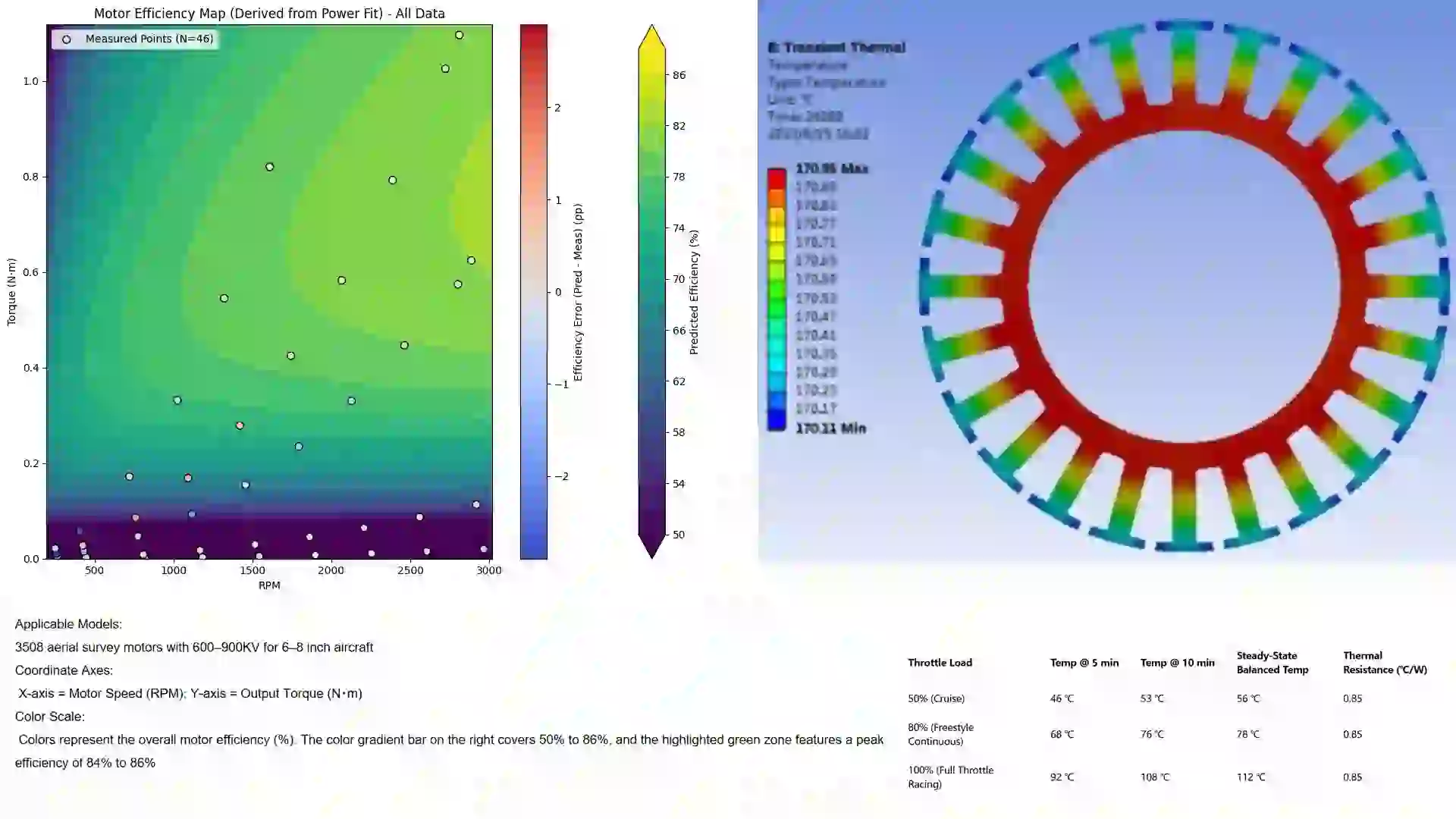
During development, I evaluate motor efficiency under real operating conditions instead of only maximum output.
Important factors include:
- Copper loss
- Iron loss
- Bearing friction
- Cooling condition
- Continuous load capability
Different UAV applications have different thermal requirements.
For example:
A racing drone may operate at high power for short periods.
An agricultural spraying drone may operate continuously for extended missions.
These two applications require completely different motor characteristics.
Excessive temperature can reduce:
- Magnet performance
- Insulation lifetime
- Bearing reliability
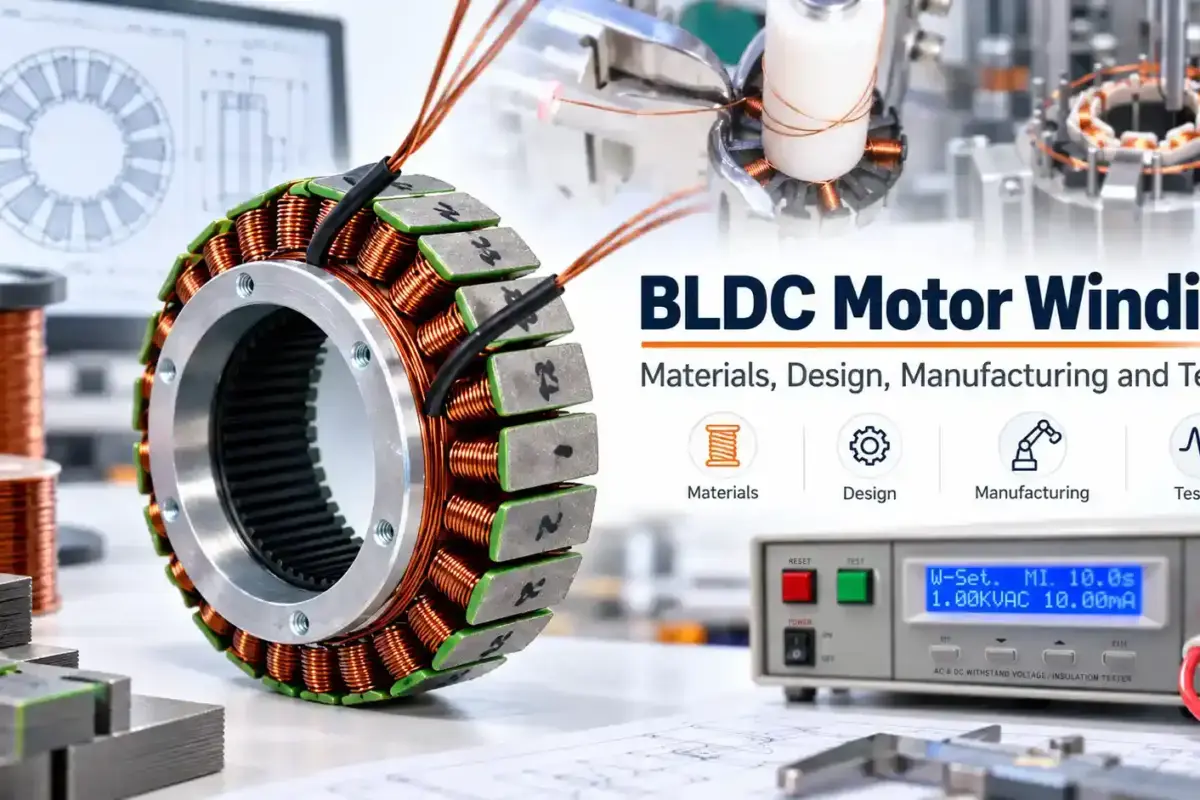
Thermal analysis and prototype testing help verify whether the motor can maintain stable performance during actual flight conditions.
6. Select the Appropriate Motor Control Method
The motor and controller should be considered as one system.
Modern UAV platforms commonly use:
- Six-step control
- Sinusoidal control
- Field-Oriented Control (FOC)
Six-step control provides:
- Simple structure
- Lower controller cost
- Easy implementation
It is suitable for cost-sensitive UAV systems.
Sinusoidal control provides:
- Lower torque ripple
- Reduced vibration
- Smoother operation
It can improve smoothness, vibration behavior, and acoustic performance.
FOC can provide:
Smooth and precise torque control
Good low-speed performance
Reduced torque ripple and vibration
High efficiency across suitable operating conditions
The appropriate control strategy depends on motor speed range, startup requirements, acoustic noise, vibration, efficiency target, ESC hardware, and flight mission. FOC can be advantageous where smooth torque, low-speed control, and reduced vibration are important, while other sensorless commutation strategies remain widely used in UAV propulsion systems.
7. Choose Sensor-Based or Sensorless Operation
Another important decision is whether the UAV motor should use position sensors.
Sensor-Based BLDC Motors
Using Hall sensors or encoders provides:
- Accurate rotor position feedback
- Better startup performance
- Improved low-speed control
They can be useful where accurate rotor position, controlled startup, or low-speed operation is required.
Sensorless BLDC Motors
Sensorless BLDC motors are widely used in UAV propulsion because they eliminate dedicated rotor-position sensors and reduce wiring, weight, and system complexity. Rotor position is typically estimated using back EMF or other observer-based methods implemented in the ESC.
Key advantages include:
- Lower hardware cost
- Fewer sensors and wiring components
- Lower weight and mechanical complexity
Sensorless control works particularly well once the motor is rotating. Startup and very-low-speed operation require dedicated control algorithms because back EMF is limited at low speed.
When Are Sensors Useful?
Hall sensors or encoders may be considered when the application requires accurate rotor position at standstill, controlled low-speed operation, specialized startup behavior, or precise closed-loop torque and position control.
For conventional multirotor propulsion—including FPV, aerial photography, surveying, and many industrial UAVs—sensorless motors are commonly used. Sensor-based operation should therefore be selected according to the actual control requirement rather than the drone category alone.
UAV Motor Selection Guide for Different Drone Applications
Different UAV platforms require different motor characteristics.
Consumer Aerial Photography Drones
Main requirements:
- Long flight time
- Low noise
- Stable hovering
- Smooth operation
The motor should prioritize:
- High efficiency
- Low vibration
- Optimized cruise performance
FPV Racing and Freestyle Drones
Main requirements:
- Fast acceleration
- High response speed
- High RPM capability
The motor should prioritize:
- Power density
- Lightweight design
- Dynamic performance
Agricultural Spraying UAVs
Agricultural drones operate under heavy continuous loads.
Typical requirements:
- High torque
- Thermal stability
- Long operating lifetime
- Large propeller compatibility
Motor selection should focus on reliability rather than short-term peak performance.
Industrial Inspection and Survey Drones
These UAVs require:
- Stable hovering
- Precise control
- Long mission duration
- Environmental reliability
Motor design should consider:
- Vibration resistance
- Temperature conditions
- Continuous operation
Heavy-Lift Cargo UAVs
Heavy-lift drones require:
- High continuous torque
- Strong mechanical structure
- High power density
In many cases, standard motors cannot achieve the required balance between:
- Payload
- Flight time
- Weight
- Efficiency
A customized motor solution may become necessary when standard motors cannot meet the required combination of thrust, weight, efficiency, and mechanical integration.
How Smart Drive Supports UAV Motor Development
Smart Drive provides complete BLDC motor development support for UAV manufacturers.
Our services include:
Custom BLDC Motor Design
We support:
- Electromagnetic optimization
- Motor structure design
- 3D CAD modeling
- Performance validation
Learn more about our Custom BLDC Motor Design Service.
UAV Motor Prototype Development
We provide:
- Prototype from 1 unit
- Fast sample development
- Functional testing
Learn more about our BLDC Motor Prototyping Service.
Low-Volume UAV Motor Manufacturing
We support:
- Pilot production
- Flexible quantities
- OEM/ODM manufacturing
Learn more about our BLDC Motor Manufacturing Service.
Conclusion
Selecting the right UAV motor requires more than comparing power ratings.
Engineers must evaluate thrust, propeller matching, efficiency, thermal performance, control strategy, and mission requirements.
Following a structured UAV Motor Selection Guide helps drone manufacturers reduce development risks and build more reliable aircraft.
At Smart Drive, we support UAV companies from motor evaluation and prototype development through low-volume and production manufacturing with custom BLDC motor solutions for UAV applications.