Introduction
Selecting the right motor supplier is one of the most important decisions in any OEM product development project. Whether you’re developing a robot, UAV, automotive subsystem, industrial machine, power tool, or smart appliance, the performance of your final product depends heavily on the capabilities of your motor partner.
Many OEM teams focus only on motor specifications and pricing, but they often overlook the importance of working with an experienced Custom BLDC Motor Manufacturer that can provide engineering support throughout the entire development cycle.
This BLDC Motor Supplier Guide explains how to choose a custom BLDC motor supplier by evaluating engineering expertise, prototyping capability, quality systems, manufacturing capacity, and long-term reliability.
By following the supplier evaluation process outlined below, OEM teams can reduce sourcing risks and accelerate product development.
How Do I Choose a Reliable BLDC Motor Manufacturer?
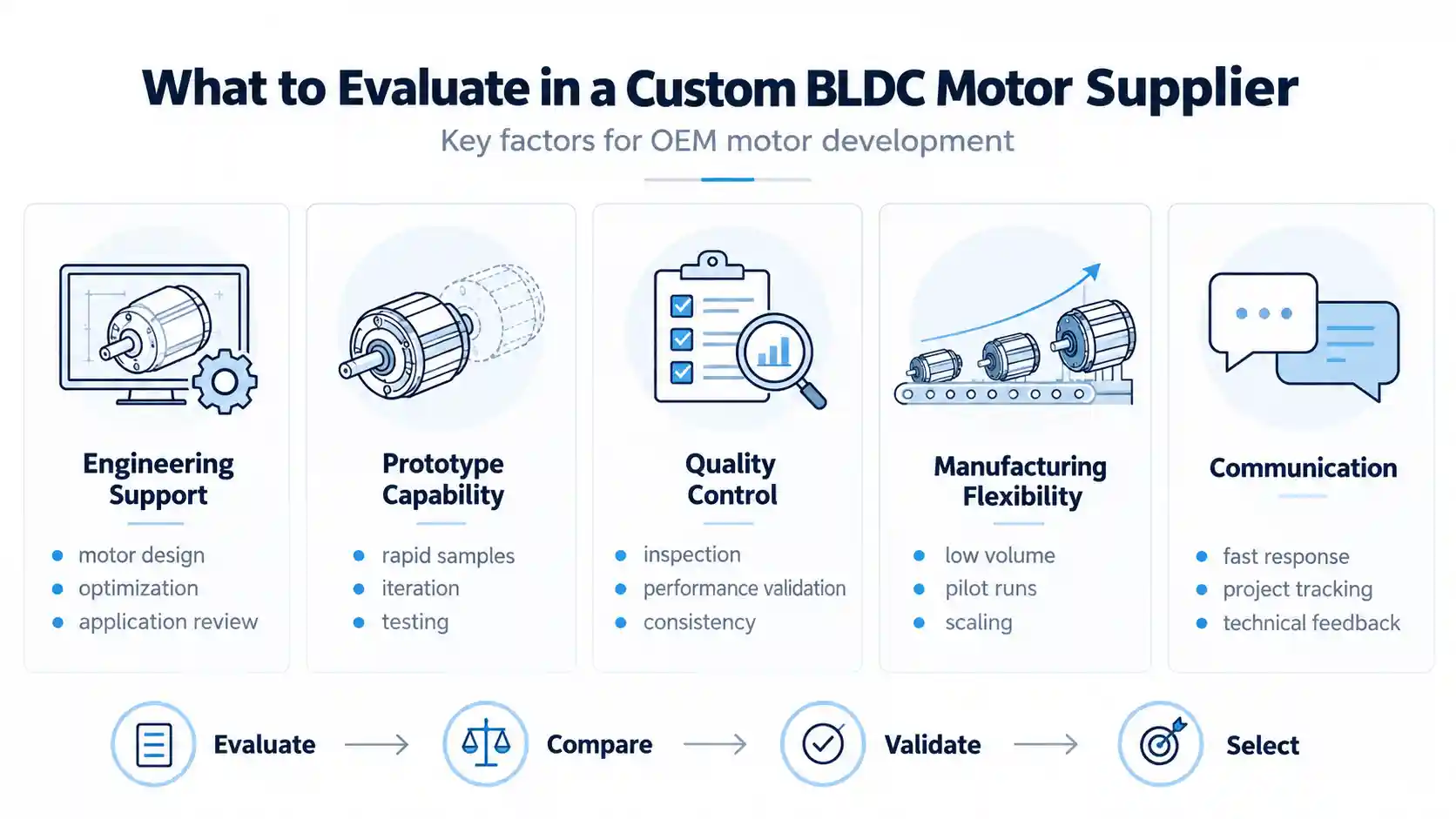
Choosing the right custom brushless DC motor manufacturer requires more than comparing price and motor specifications. OEM teams should evaluate engineering capability, quality management, prototype support, manufacturing flexibility, and project communication.
A reliable supplier should be able to support both technical development and production execution while maintaining consistent quality and clear communication throughout the project
Verify Certifications and Quality Management Systems
A professional brushless motor supplier should maintain appropriate quality management systems and understand the product compliance requirements of the target market.
Quality management systems
- ISO 9001
- IATF 16949 for applicable automotive projects
Product compliance, where required
- CE
- RoHS
- UL-related requirements
Quality certifications alone do not guarantee success, but they indicate that the manufacturer follows documented production and inspection procedures.
In addition to certifications, ask suppliers about:
- Incoming material inspection
- Dynamic balancing procedures
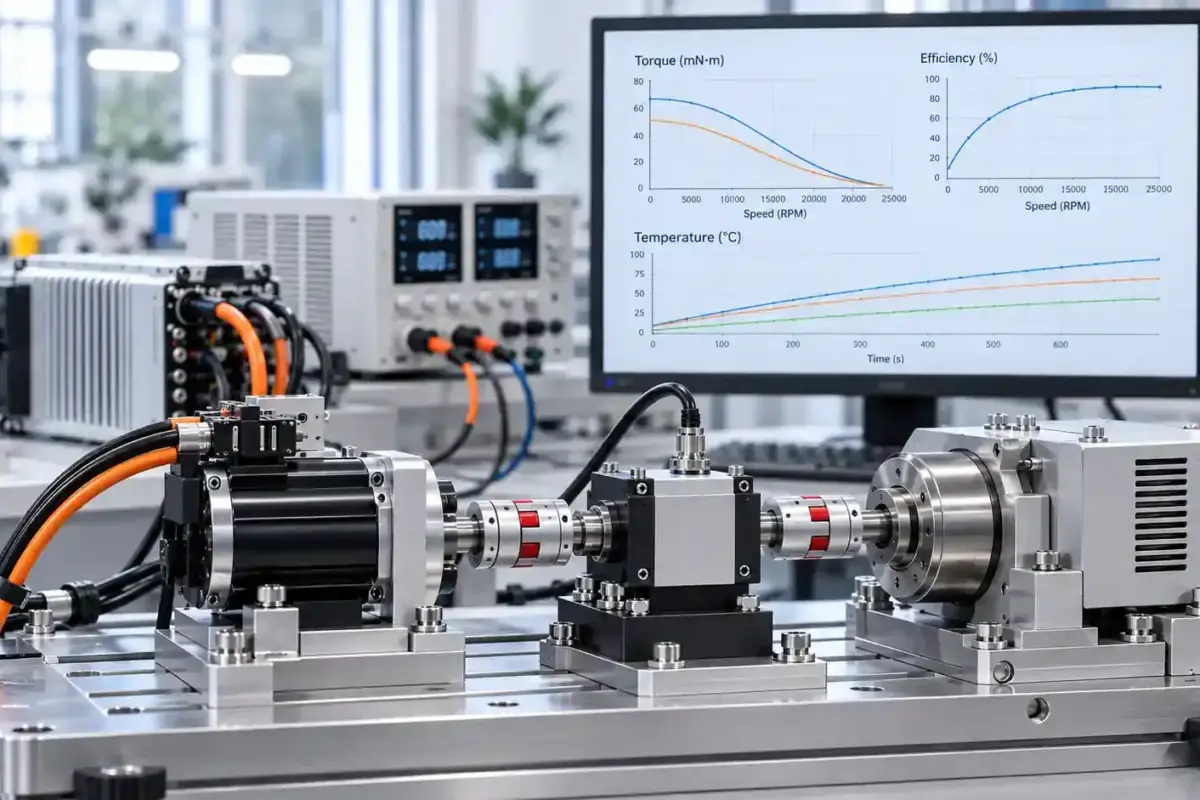
- Torque-speed testing
- Thermal testing
- End-of-line quality control
Strong quality systems help minimize warranty risks and field failures.
Evaluate Engineering and Customization Capabilities
The most valuable suppliers contribute engineering expertise—not just manufacturing capacity.
A qualified supplier should support:
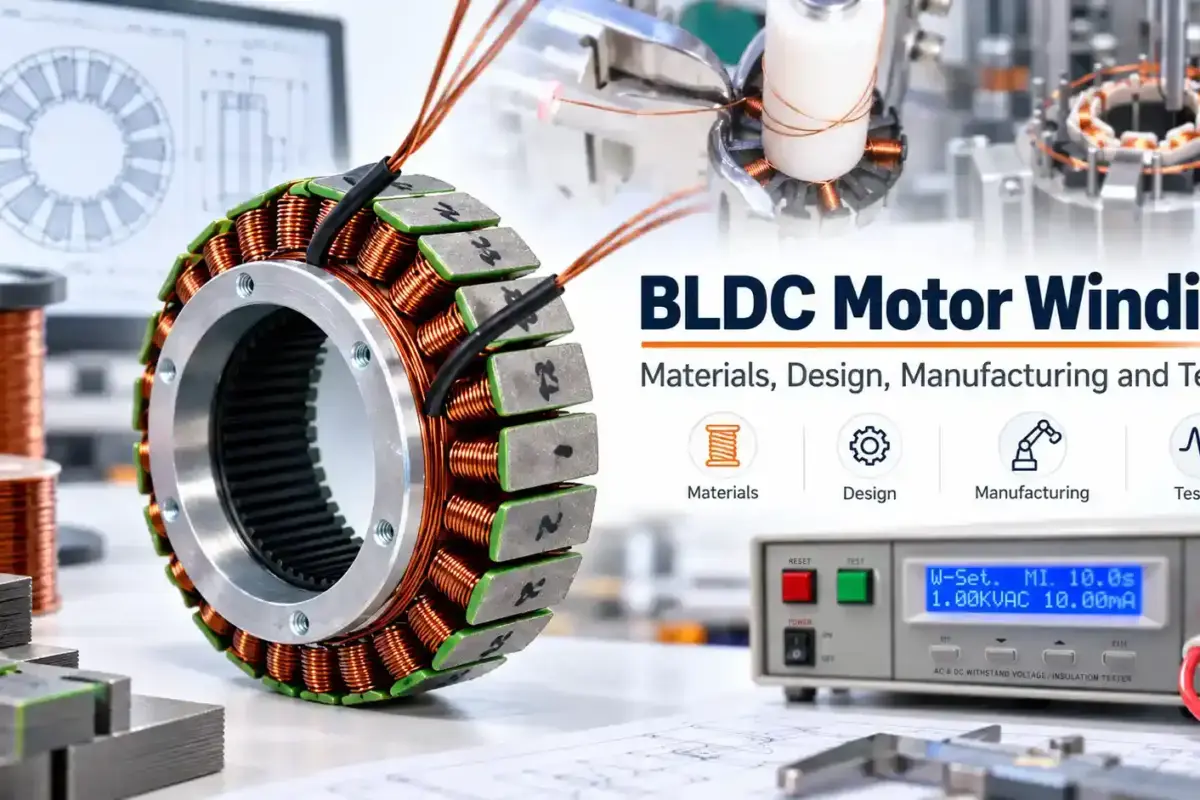
- Custom winding configurations
- Voltage optimization
- Torque-speed curve development
- Thermal management improvements
- Mechanical integration support
- Electromagnetic simulation
When evaluating a supplier, ask whether they can assist with:
- New motor development
- Reverse engineering
- Motor optimization
- Prototype iteration
These capabilities are typically delivered through a professional BLDC Motor Design Service, where electromagnetic simulation, mechanical optimization, and application-specific engineering are completed before prototyping begins.
Compare Prototype Lead Times
Slow prototyping is a common cause of delays in OEM motor development projects.
Prototype lead time varies depending on motor structure, tooling requirements, component availability, and design complexity. Suppliers with flexible prototype processes and rapid engineering iteration can help shorten the development cycle.
For suitable projects, Smart Drive supports rapid prototype development before full production tooling is finalized.
Fast prototyping allows engineering teams to validate performance earlier and shorten overall product development schedules. A professional BLDC Motor Prototyping Service can provide functional samples for testing before production tooling is finalized.
When learning how to choose a custom BLDC motor supplier, prototype lead time should always be considered alongside pricing and manufacturing capability.
Assess Communication and Project Management
Communication quality is often overlooked during supplier selection.
Warning signs include:
- Slow email responses
- Incomplete technical answers
- Lack of engineering participation
- Unclear timelines
A strong supplier should provide:
- Dedicated project contacts
- Clear milestone tracking
- Fast technical feedback
- Regular progress updates
Good communication reduces misunderstandings and accelerates decision-making throughout development.
Can the Supplier Support Low-Volume Production?
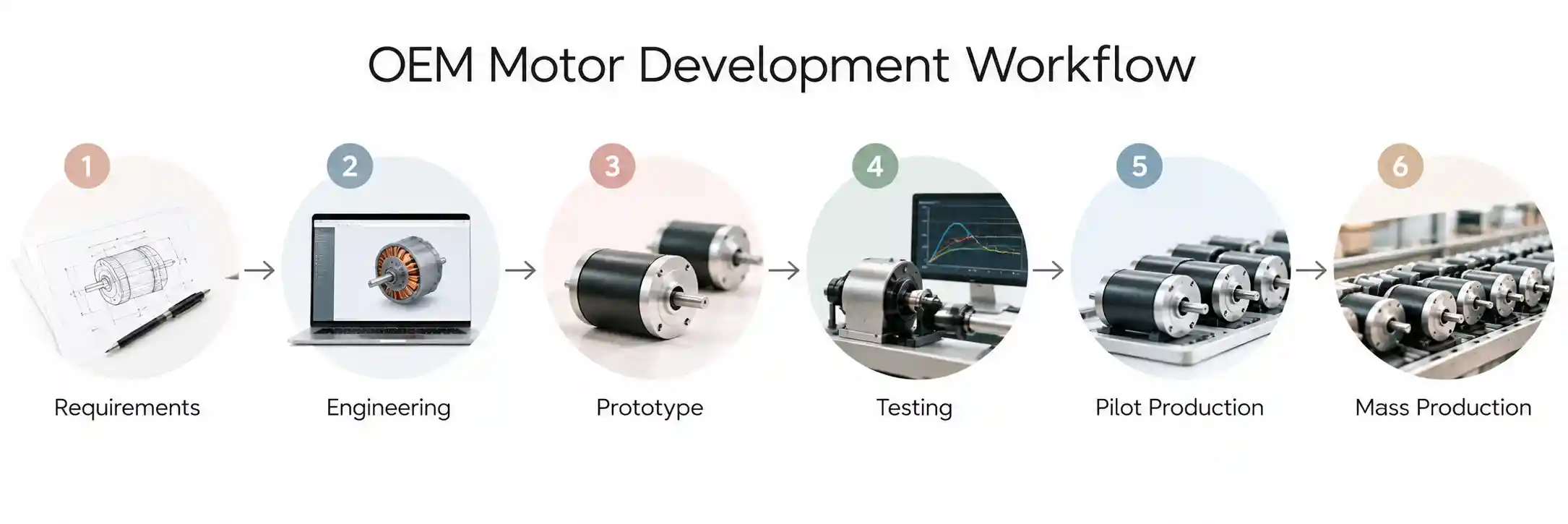
Many OEM projects require pilot production before full commercialization.
Look for suppliers that can support:
- Prototype quantities (1–10 units)
- Engineering validation builds
- Pilot production runs
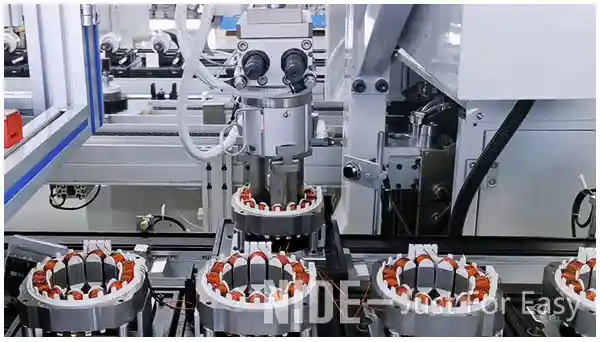
- Low-volume manufacturing
- Full-scale production
Suppliers offering Low Volume BLDC Motor Manufacturing make it much easier to transition from engineering validation to commercial production without changing manufacturing partners.
This flexibility reduces risk during early-stage development and simplifies future scaling.
Common Mistakes When Choosing a BLDC Motor Supplier
Many sourcing teams make avoidable mistakes.
Choosing Based on Price Alone
The cheapest option often creates hidden costs through delays, quality issues, and redesigns.
Ignoring Prototype Lead Times
Slow prototypes directly delay product validation and launch schedules.
Failing to Evaluate Engineering Support
Without technical collaboration, optimization opportunities are often missed.
Overlooking Manufacturing Scalability
A supplier capable of producing prototypes may not be capable of supporting mass production.
Avoiding these mistakes can save significant time and development costs.
Which Industries Benefit Most from Custom BLDC Motor Suppliers?
Custom brushless motor development is widely used in:
Robotics
Robotics applications often require a Custom Robotics BLDC Motor with high torque density, compact dimensions, and precise motion control.
UAV & Drone Systems
Lightweight structures and high efficiency.
Automotive Applications
Thermal management and long-term reliability.
Electric Marine Propulsion
Waterproof and corrosion-resistant motor systems.
Power Tools
High power density and overload capability.
Small Home Appliances
Low noise, compact size, and energy efficiency.
Cross-industry experience often enables suppliers to transfer valuable engineering knowledge between applications.
Conclusion
If you’re evaluating a new motor project, you can Request a Custom BLDC Motor Quote to receive engineering feedback, feasibility analysis, and prototype recommendations within 48 hours.
Understanding how to choose a custom BLDC motor supplier is about much more than comparing prices.
The right supplier should provide engineering expertise, fast prototyping, quality assurance, manufacturing flexibility, and responsive communication throughout the entire development process.
A structured evaluation approach helps OEM teams reduce supply chain risks, accelerate product launches, and achieve better long-term product performance.
Following this BLDC Motor Supplier Guide will help you identify reliable partners and avoid costly sourcing mistakes.