Introduction
Selecting the right motor is one of the most important decisions during product development.
Many engineering teams choose motors based only on voltage, speed, or price. However, a motor that looks suitable on a datasheet may fail after integration because of insufficient torque, overheating, vibration, noise, or poor efficiency.
At Smart Drive, we help OEM teams select a BLDC motor based on real application requirements, including torque, speed, voltage, mechanical dimensions, thermal conditions, and control requirements.
The correct BLDC motor selection process starts by understanding the complete operating environment, not just the motor specifications. A suitable motor should match the application’s performance targets while providing reliability, efficiency, and easy integration.
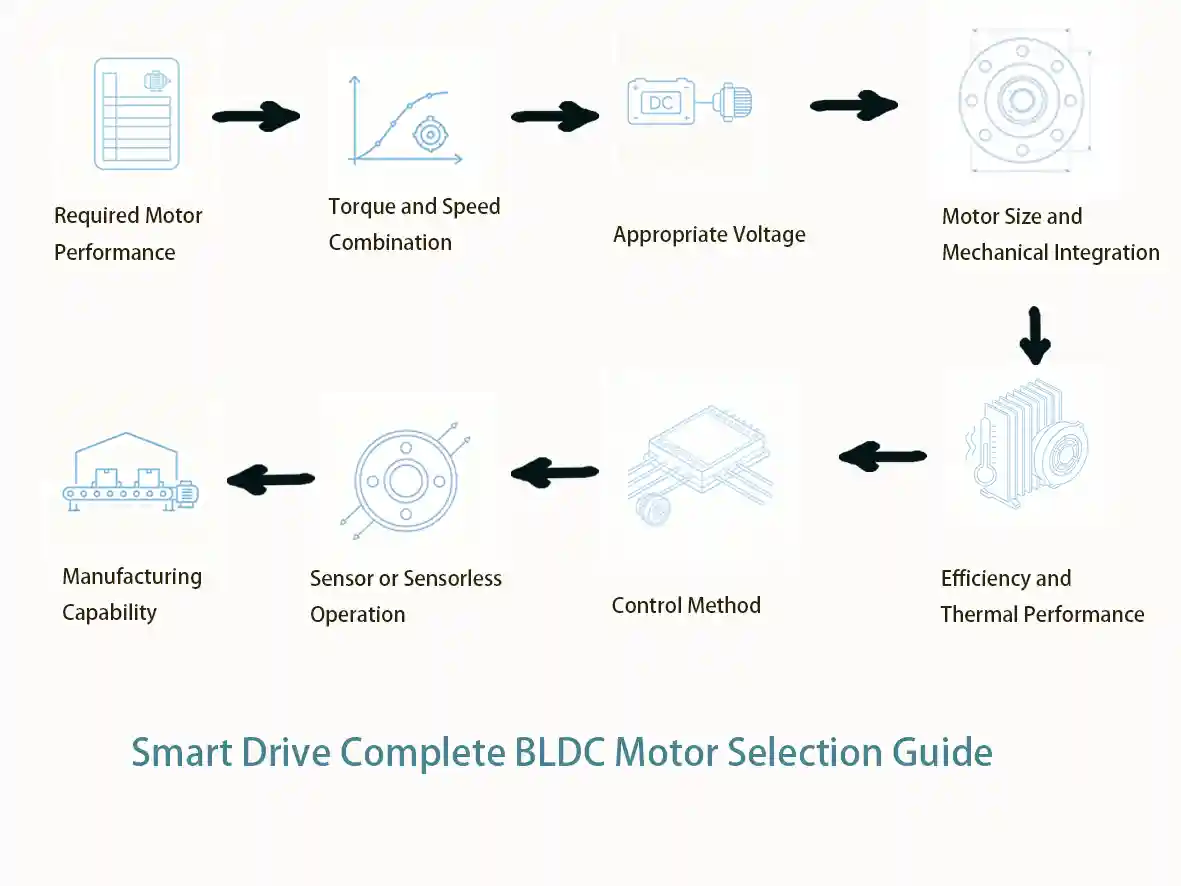
In this guide, we explain the key factors engineers should consider when selecting a BLDC motor. This BLDC Motor Selection Guide covers electrical, mechanical, thermal, and manufacturing considerations to help OEM teams make better decisions.
1. Define Your Required Motor Performance
Before selecting a BLDC motor, we first define the required operating conditions.
The most important parameters include:
- Voltage
- Rated speed
- Maximum speed
- Continuous torque
- Peak torque
- Power output
- Duty cycle
- Operating environment
A motor designed for continuous operation requires different characteristics compared with a motor used for short acceleration cycles.
For example, a pump motor may prioritize efficiency and long lifetime, while a robotic actuator may require precise torque control and fast response.
2. Select the Correct Torque and Speed Combination
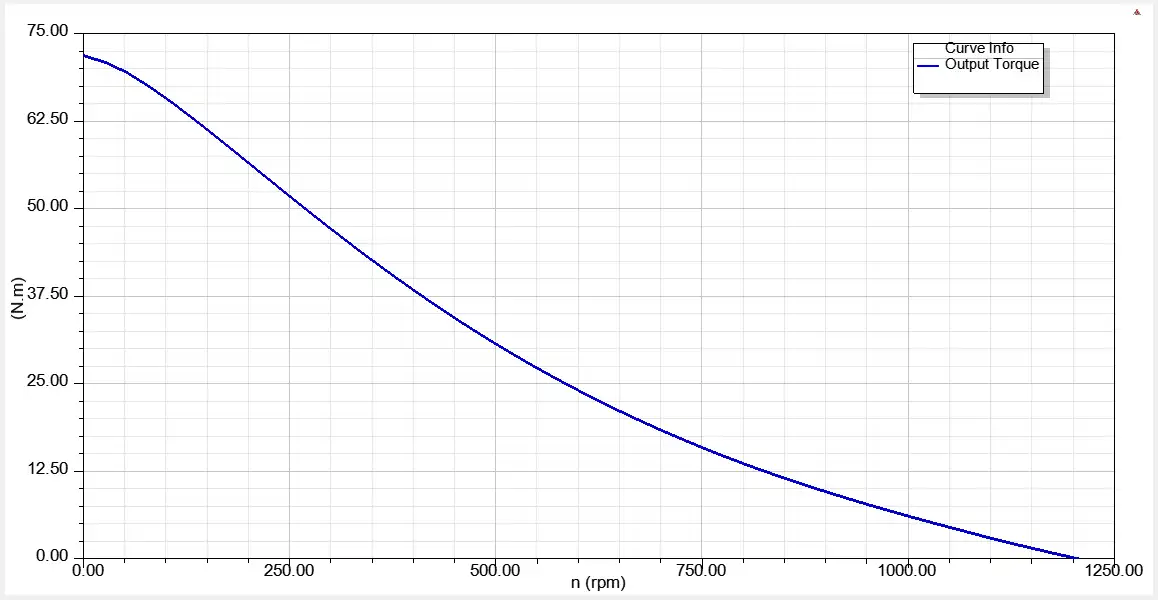
When deciding how to select a BLDC motor, torque and speed should always be evaluated together rather than as independent parameters.
The relationship between power, torque, and speed determines the motor capability.
For the same power requirement, operating at a higher speed can reduce the required torque and may allow a more compact motor design. However, the final motor size and power density also depend on electromagnetic loading, cooling, mechanical speed limits, and efficiency requirements.
For complex projects requiring optimized performance, engineers often need support from a professional Custom BLDC Motor Manufacturer.
3. Choose the Appropriate Voltage
Voltage selection affects motor efficiency, current consumption, and thermal performance.
Common nominal BLDC motor system voltages include:
- 12V
- 24V
- 36V
- 48V
- Higher voltage systems
A higher voltage system can reduce current for the same power output. Lower current can reduce I²R losses in the motor windings and electrical system, which may improve thermal performance when the motor and controller are properly designed for the selected voltage.
However, voltage selection must also consider:
- Battery system compatibility
- Controller availability
- Safety requirements
- Application standards
4. Consider Motor Size and Mechanical Integration
A motor is not only an electrical component.
It must physically fit into the final product.
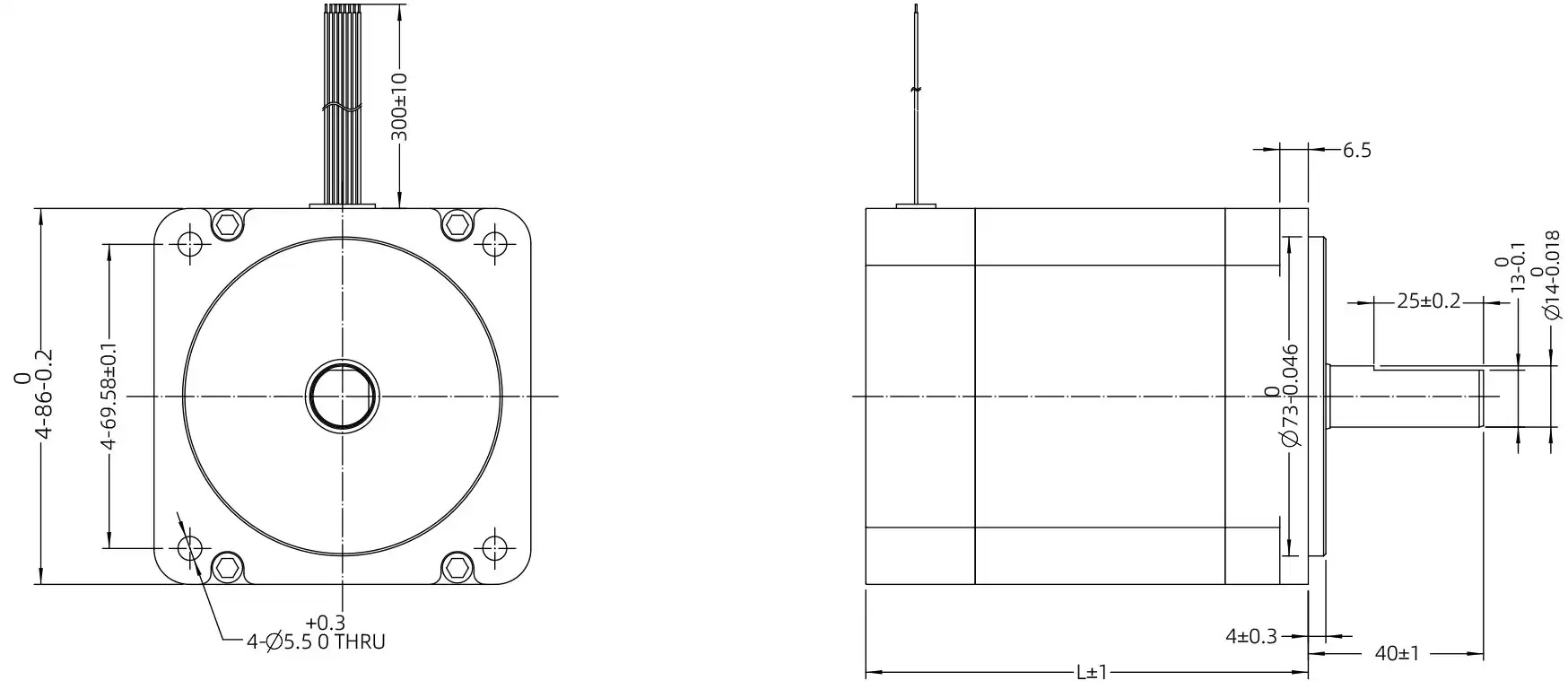
When learning how to select a BLDC motor for a specific product, engineers should also evaluate the mechanical integration requirements carefully:
- Outer diameter
- Motor length
- Shaft dimensions
- Mounting holes
- Flange design
- Connector position
- Weight limitations
A standard motor may provide acceptable performance but fail because it cannot integrate into the available mechanical space.
For this reason, many OEM projects may require a customized motor solution rather than an off-the-shelf product.
5. Evaluate Efficiency and Thermal Performance
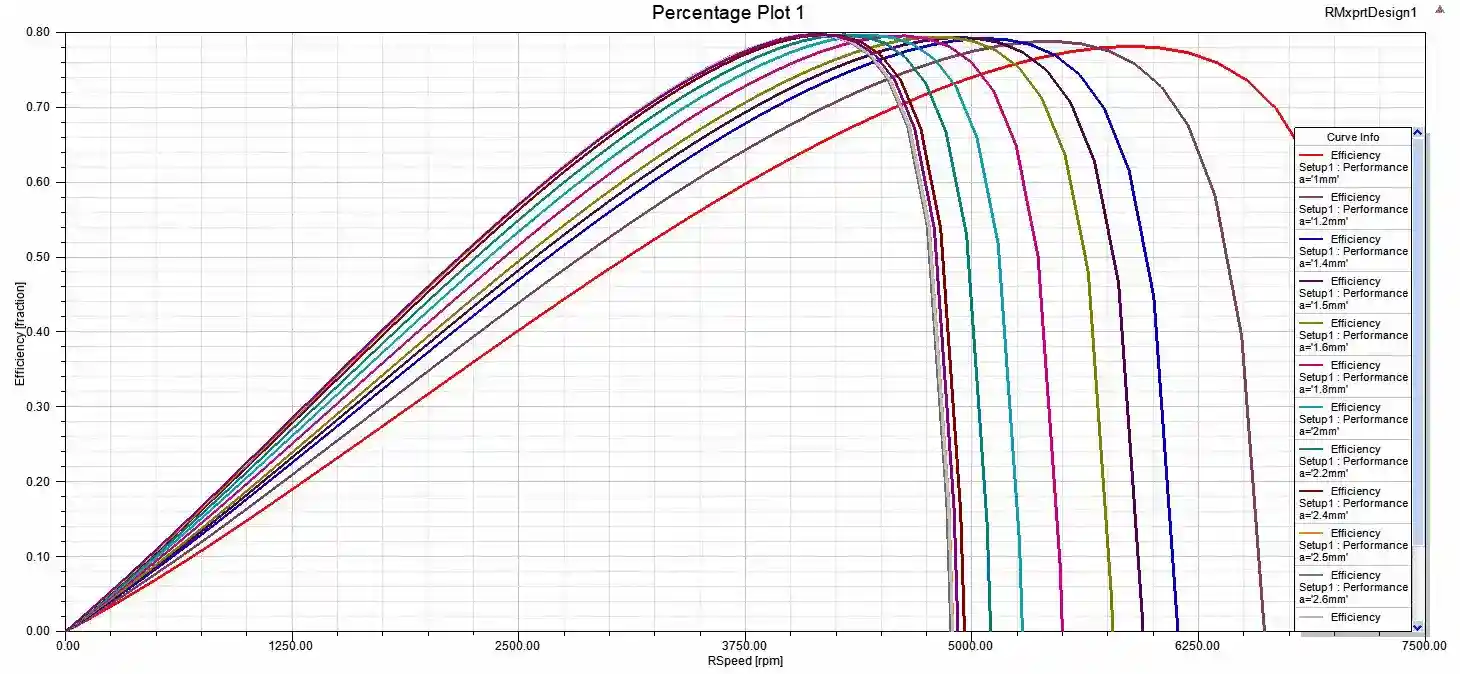
Motor efficiency directly affects operating temperature and product reliability.
A low-efficiency motor creates additional heat.
Excessive heat can reduce:
- Magnet performance
- Bearing lifetime
- Insulation reliability
- Electronic component life
When we help customers select a BLDC motor, we evaluate:
- Copper loss
- Iron loss
- Cooling conditions
- Continuous operating temperature
- Thermal limitations
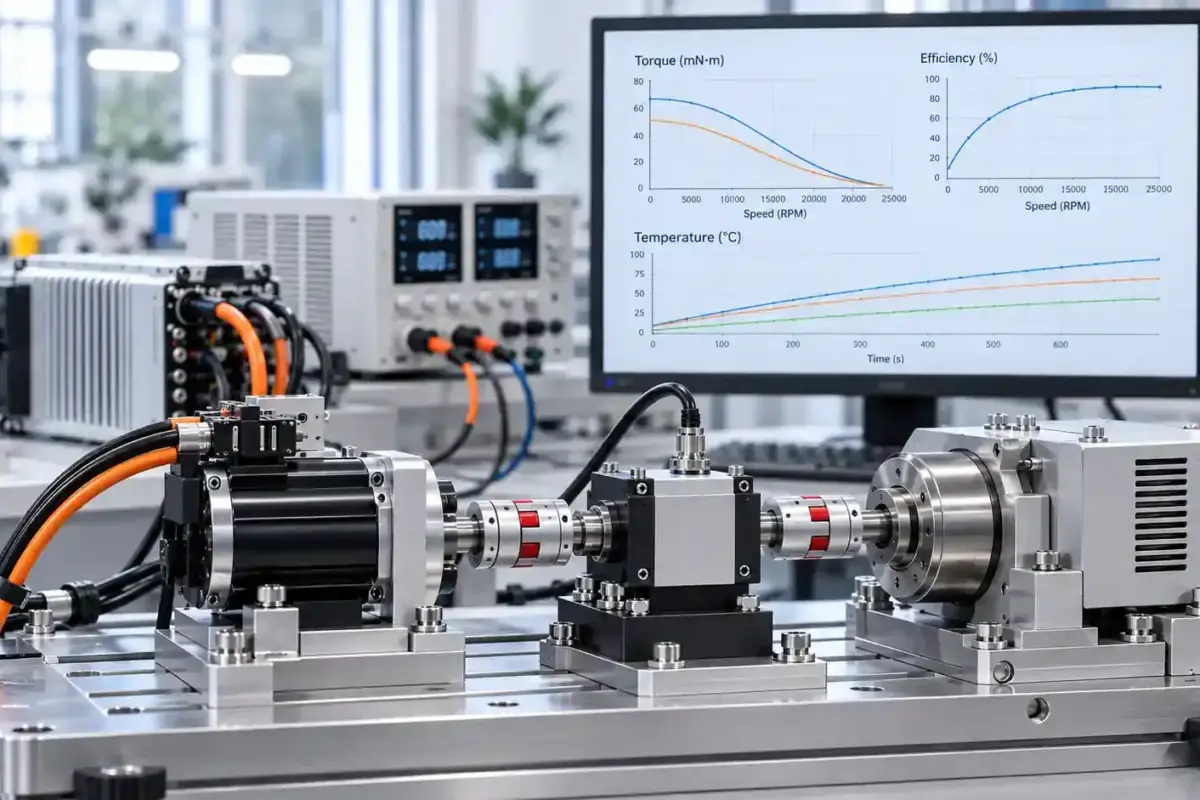
Thermal simulation and testing are important steps before moving into production.
You can learn more about our engineering approach through our BLDC Motor Design Service.
6. Select the Right Control Method
The controller has a major influence on BLDC motor performance.
Different applications require different control strategies.
Six-Step Control
Six-step control is the simplest BLDC control method.
Advantages:
- Low controller cost
- Simple implementation
- Reliable operation
Limitations:
- Higher torque ripple
- More vibration
- Higher noise
It is suitable for applications where cost and simplicity are priorities.
Sinusoidal Control
Sinusoidal control provides smoother current waveforms.
Benefits include:
- Lower vibration
- Reduced noise
- Improved smoothness
Compared with six-step control, sinusoidal control can provide smoother operation and lower acoustic noise, but it requires more advanced control algorithms.
Field-Oriented Control (FOC)
FOC is an advanced motor control method widely used where precise torque and smooth operation are required.
It independently controls:
- Magnetic flux
- Torque production
FOC can provide:
- Smooth and precise torque control
- Good low-speed performance
- Reduced torque ripple and vibration
- High efficiency across suitable operating conditions
FOC is often considered when precise torque control, smooth operation, low-speed performance, or reduced vibration are important.
7. Choose Sensor or Sensorless Operation
BLDC motors can operate with or without position sensors.
Sensor-Based BLDC Motors
Hall sensors, magnetic encoders, or other position sensors can provide rotor-position feedback to the controller.
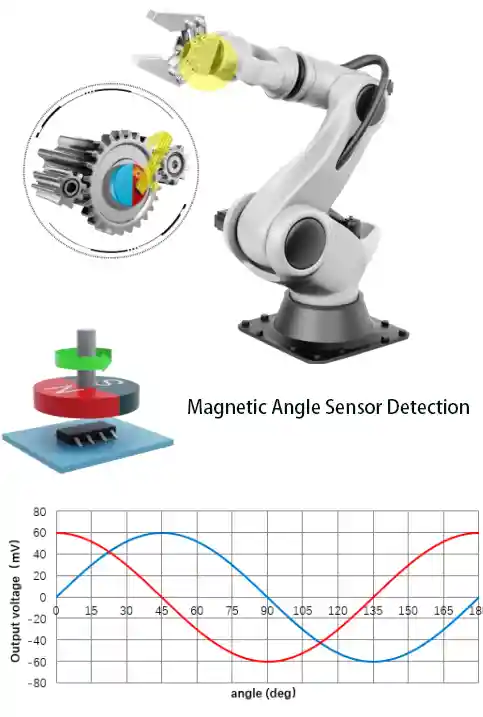
Advantages:
- Better starting performance
- Accurate low-speed control
- Improved control at standstill and very low speed
Sensorless BLDC Motors
The controller typically estimates rotor position using back EMF or other observer-based methods.
Advantages:
- Lower hardware cost
- Fewer sensors and wiring components
- Simpler motor and wiring integration
The best choice depends on speed range, control accuracy, and system requirements.
8. Consider Prototype and Manufacturing Feasibility
A motor design is only successful when it can be manufactured consistently.
When evaluating whether a motor solution can move successfully from prototype to production, engineers should consider:
- Engineering capability
- Prototyping capability
- Testing capability
- Production experience
- Quality management
A practical motor solution should support a clear path from engineering validation to production:
Concept Design → Prototype → Testing → Low-Volume Production → Mass Production
At Smart Drive, we support OEM customers from initial motor evaluation through BLDC motor prototyping and production.
Common Mistakes When Selecting a BLDC Motor
During development projects, I often see several common mistakes.
Choosing Only Based on Price
The lowest-cost motor is not always the lowest-cost solution.
Poor performance may create:
- Redesign costs
- Testing delays
- Product failures
Ignoring Thermal Conditions
A motor that performs well in short testing may fail during continuous operation.
Selecting Based Only on Maximum RPM
Maximum speed does not represent real application performance.
Torque, efficiency, and operating conditions are equally important.
Ignoring the Continuous Operating Point
Peak torque and maximum speed do not show how the motor will perform during normal operation. Always verify continuous torque, continuous speed, efficiency, and temperature at the actual operating point.
How Smart Drive Helps Engineers Select the Right BLDC Motor
At Smart Drive, we do not simply provide catalog motors.
We develop custom BLDC motor solutions based on:
- Required torque
- Speed range
- Voltage
- Mechanical dimensions
- Efficiency targets
- Environmental requirements
Our engineering process includes:
- Electromagnetic analysis
- Mechanical design
- Prototype development
- Performance testing
- Low-volume manufacturing
For OEM teams developing new products, selecting the correct motor early can significantly reduce development risk.
Conclusion
To select a BLDC motor successfully, engineers need to consider more than voltage and speed.
Torque, efficiency, thermal performance, control method, mechanical integration, and manufacturing capability all influence the final result.
This BLDC Motor Selection Guide provides a practical framework for evaluating motor performance, mechanical integration, thermal requirements, control strategy, and manufacturing feasibility.