How to Design a Custom BLDC Motor: A Complete BLDC Motor Design Guide
Introduction
Designing a brushless DC motor is rarely as simple as selecting a standard catalog model. Every application has unique requirements for torque, speed, efficiency, size, thermal performance, and service life. Whether you’re developing a robot, UAV, electric vehicle subsystem, power tool, or smart appliance, a well-executed custom BLDC motor design can significantly improve overall product performance while reducing long-term manufacturing costs.
This BLDC Motor Design Guide explains the complete engineering workflow used by OEM manufacturers—from defining performance targets and selecting the right motor architecture to electromagnetic simulation, prototype validation, and production preparation.
If you’re wondering how to design a custom BLDC motor, this guide walks through every major step in the process.
Why Design a Custom BLDC Motor Instead of Using a Standard Motor?
Standard brushless motors are designed to satisfy general-purpose applications.
Unfortunately, most OEM products are not general-purpose.
Every product places different demands on the motor.
For example:
- Robotics require precise positioning, smooth motion, and high torque density.
- UAVs prioritize lightweight construction and maximum power density.
- Automotive systems require long service life, thermal stability, and vibration resistance.
- Power tools demand high overload capability and efficient cooling.
- Marine propulsion systems require waterproof construction and corrosion resistance.
When engineers design a custom BLDC motor, every parameter is optimized specifically for the application instead of forcing the product to adapt to a standard motor.
Step 1 – Define Your BLDC Motor Requirements
Every successful custom motor project begins with accurate engineering requirements.
Incomplete specifications almost always lead to additional design iterations, longer development cycles, and higher costs.
Typical design inputs include:
- Operating voltage
- Rated speed (RPM)
- Continuous torque
- Peak torque
- Output power
- Duty cycle
- Ambient temperature
- Cooling conditions
- Installation space
- Weight limitations
- Target efficiency
- Cost objectives
The more complete the initial specifications, the faster engineers can move into the custom BLDC motor design process.
Step 2 – Define Performance Targets
Motor performance is usually divided into four engineering categories.
Mechanical Requirements
- Motor diameter
- Motor length
- Shaft dimensions
- Mounting interface
- Weight limitations
Electrical Requirements
- Voltage
- Current
- Rated power
- Controller compatibility
- Efficiency target
Environmental Requirements
- Operating temperature
- Humidity
- Dust protection
- Waterproof rating
- Corrosion resistance
Reliability Requirements
Engineers should also define:
- Expected service life
- Maintenance interval
- Continuous operating hours
- Required safety margin
These requirements establish the foundation for the entire BLDC motor design guide.
Step 3 – Select the Right BLDC Motor Architecture
One of the earliest design decisions is selecting the appropriate motor structure.
Inrunner Motors
Inrunner motors place the rotor inside the stator.
Advantages include:
- Higher rotational speed
- Better heat dissipation
- Compact construction
- Excellent dynamic response
Typical applications:
- Industrial equipment
- Automotive pumps
- Compressors
- High-speed fans
Outrunner Motors
Outrunner motors place the rotor outside the stator.
Advantages include:
- Higher torque
- Better torque density
- Lower operating speed
- Higher efficiency at low RPM
Typical applications:
- UAV propulsion
- Robotics
- Electric bicycles
- Marine thrusters
Selecting the proper architecture is one of the most important decisions in how to design a custom BLDC motor.
Step 4 – Calculate Voltage, Power, Torque and Speed
Motor sizing depends on balancing several key parameters.
Higher voltage generally reduces operating current, improving efficiency and reducing copper losses.
Power can be calculated as:
Power = Torque × Angular Velocity
Engineers evaluate:
- Battery compatibility
- Controller capability
- Continuous power
- Peak overload
- Thermal limits
A balanced design provides high efficiency without unnecessary oversizing.
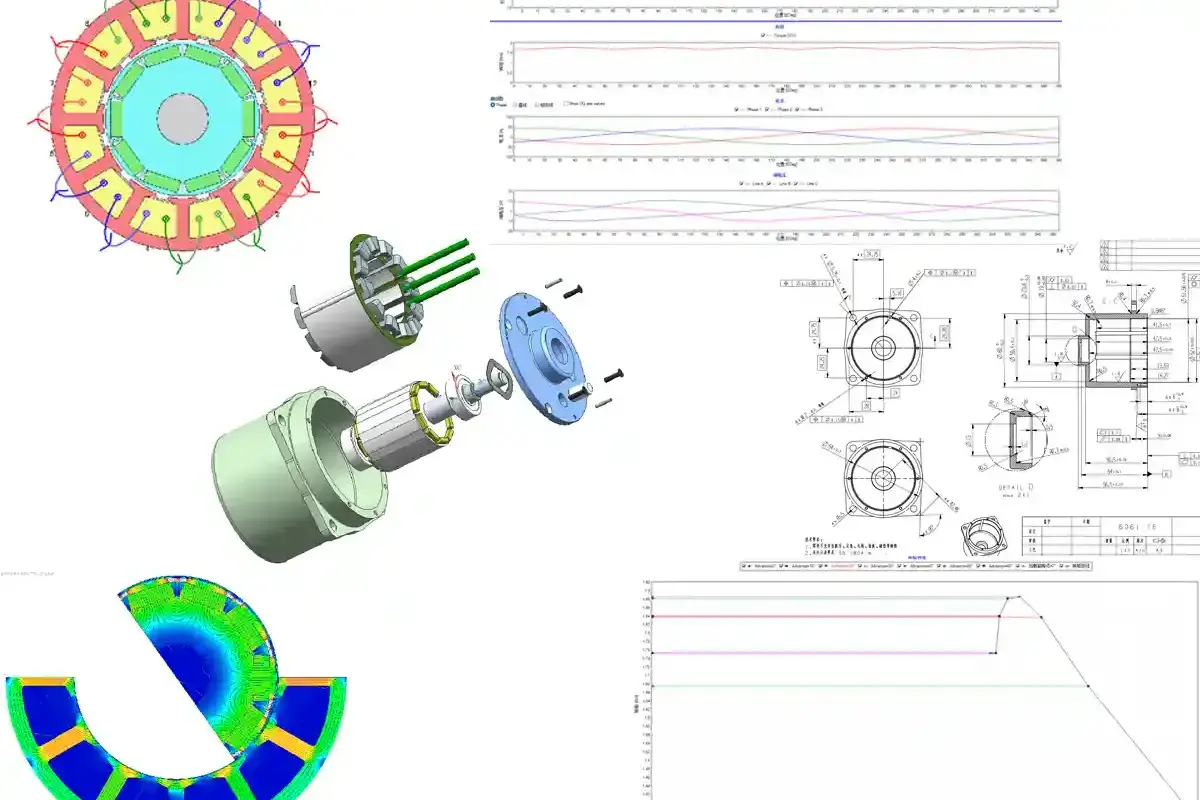
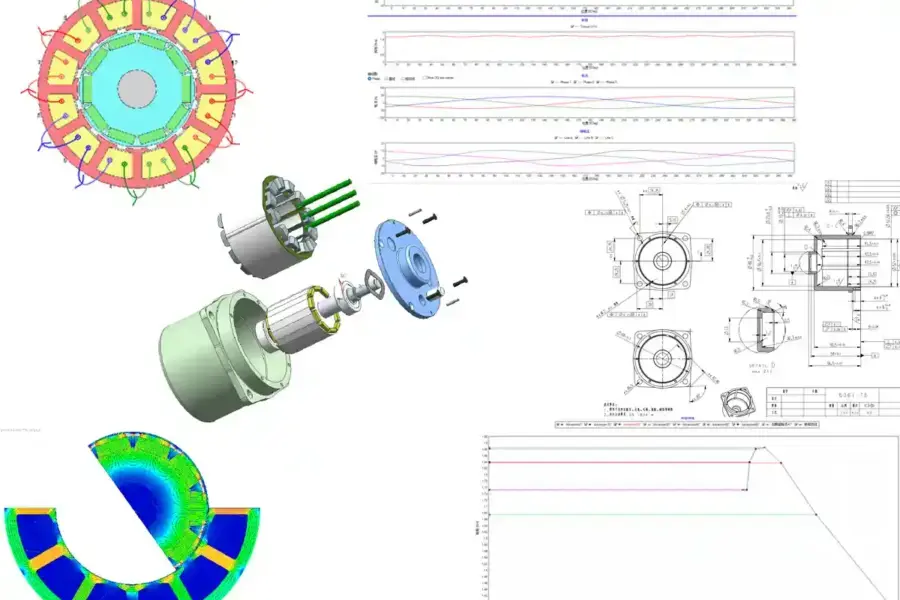
Step 5 – Optimize Electromagnetic Design
Electromagnetic optimization largely determines motor efficiency.
This stage typically includes:
- Pole and slot selection
- Air-gap optimization
- Magnet selection
- Flux density analysis
- Cogging torque reduction
- Torque ripple optimization
- Back-EMF analysis
Modern BLDC motor electromagnetic design relies heavily on finite element analysis (FEA), allowing engineers to predict motor performance before manufacturing a prototype.
Step 6 – Design the Stator and Windings
The stator generates the rotating magnetic field that drives the motor.
A well-designed winding significantly influences:
- Torque output
- Efficiency
- Temperature rise
- Starting performance
- Noise level
During BLDC motor winding design, engineers optimize:
- Slot configuration
- Wire gauge
- Fill factor
- Winding pattern
- Number of turns
- Insulation system
Proper winding optimization improves efficiency while reducing manufacturing costs.
Step 7 – Thermal Design and Cooling
Heat is one of the biggest factors affecting long-term motor reliability.
Excessive temperatures accelerate the aging of:
- Permanent magnets
- Insulation materials
- Bearings
- Electronic components
Common cooling methods include:
- Natural convection
- Forced air cooling
- Water cooling
- Heat sink integration
- Housing optimization
A robust high-efficiency BLDC motor design always includes thermal analysis during the engineering phase.
Step 8 – Build and Test the Prototype
Simulation reduces risk.
Prototype testing confirms reality.
A custom BLDC motor prototype is typically evaluated through:
- Torque testing
- Speed testing
- Efficiency measurement
- Thermal testing
- Noise testing
- Vibration testing
- Dynamic balancing
- Back-EMF testing
Prototype validation helps engineers identify optimization opportunities before production.
Step 9 – Prepare for Manufacturing
A successful prototype does not automatically guarantee successful production.
Design for Manufacturability (DFM) ensures the motor can be produced consistently at scale.
Important considerations include:
- Material availability
- Manufacturing tolerances
- Assembly processes
- Supply chain stability
- Quality inspection
- Production cost
Early manufacturing planning shortens lead times and reduces overall development risk.
Common Mistakes to Avoid
Many OEM projects experience delays because of avoidable mistakes.
The most common include:
- Incomplete performance specifications
- Ignoring thermal management
- Overlooking manufacturing constraints
- Designing only for peak performance
- Skipping prototype validation
- Selecting unsuitable magnetic materials
Avoiding these issues greatly improves project success.
Final Thoughts
Understanding how to design a custom BLDC motor requires much more than selecting magnets or calculating winding turns.
Successful projects combine application analysis, electromagnetic optimization, mechanical engineering, prototype validation, and manufacturing planning into one structured development process.
Following a proven BLDC Motor Design Guide helps engineers reduce technical risks, shorten development cycles, and achieve higher efficiency, better reliability, and lower production costs.
Whether you’re developing motors for robotics, UAVs, automotive systems, industrial automation, marine propulsion, or smart appliances, investing in a well-planned custom motor design process leads to better long-term performance and faster product commercialization.
Need Help Designing a Custom BLDC Motor?
If you’re evaluating a new motor project, our engineering team can help you define specifications, review feasibility, and recommend the most suitable motor architecture. From electromagnetic design and rapid prototyping to low-volume manufacturing, we provide end-to-end support for OEM developers.
Share your project requirements today to receive a free engineering evaluation within 48 hours.